
Categories
Real Life Real Estate, Selling / Buying, What's Jeff's Take on this?, Straight TalkPublished November 4, 2026
Book Smart vs. Street Smart: The Cost of Trying to Time the Market 🧠📈

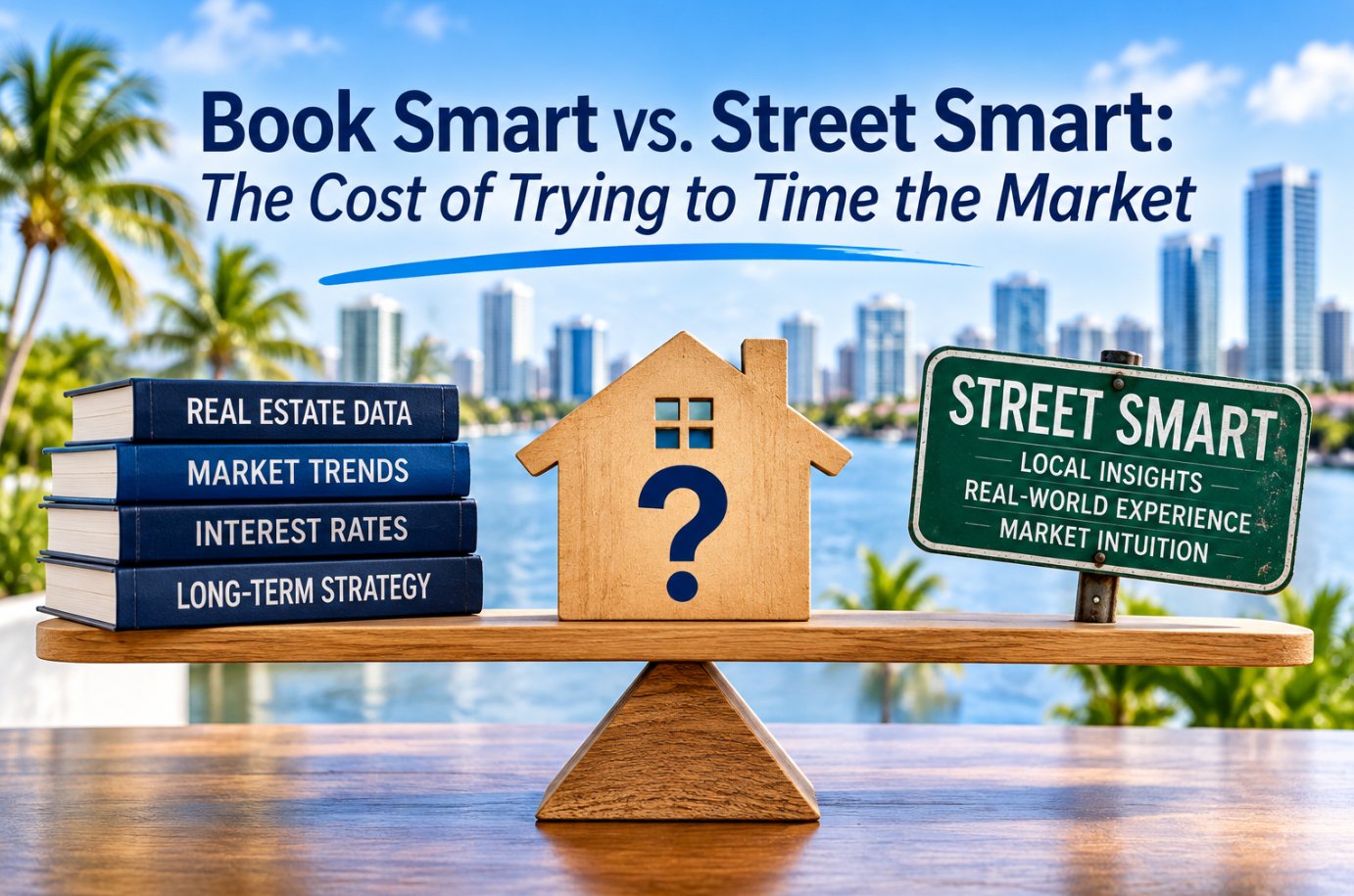
I have learned this in my over 3 decades of real estate sales. Every homebuyer steps into the market with a distinct operating system. In real estate, those systems divide cleanly into two camps: the Book Smart buyer and the Street Smart buyer.
Both want to build long-term wealth and get the best possible deal. Where they stumble—and where it costs them tens of thousands of dollars in real equity—is in how they attempt to "time the market."
The BLUF (Bottom Line Up Front): Trying to time the real estate market is a vanity exercise. Whether you are paralyzed by spreadsheets or chasing quick-flip intuition, waiting for the "perfect moment" to purchase real property carries a compounding price tag. Historical national data proves that real estate appreciates at a baseline average of roughly 4% per year. While various regional pockets appreciate much faster, banking on that steady 4% compounding rate, without question, beats speculative timing every single time.
The Two Profiles: How They Approach the Search
To understand why buyers miss the mark, look at how their psychology works when searching for a home:
1. The Book Smart Buyer (The Analytical Optimizer)
- The Profile: Highly educated, data-obsessed, and spreadsheet-driven. They track the 10-Year Treasury yield, analyze historical price-per-square-foot ratios down to two decimal places, and study municipal zoning updates.
- Their Timing Trap: Analysis paralysis. The Book Smart buyer tries to time the market by out-calculating it. They wait for interest rates to drop exactly 50 basis points, or for inventory to rise by an often "self enduced" mathematically projected percentage.
- The Cost: While they wait for absolute economic certainty, home prices continue to tick upward, effectively pricing them out of the exact neighborhoods they spent months studying.
2. The Street Smart Buyer (The Intuitive Operator)
- The Profile: Decisive, relationship-oriented, and opportunity-driven. They don't care about macroeconomic charts; they care about leverage, seller motivation cues, and transactional momentum.
- Their Timing Trap: The bottom-feeder fallacy. The Street Smart buyer tries to time the market by waiting for a seller in distress or hunting for an asymmetric "steal." They refuse to write realistic offers because they are convinced a sudden crash or wave of foreclosures is right around the corner.
- The Cost: They cycle through lowball offers, get repeatedly outbid by serious (Real) buyers, and burn daylight while real estate values march forward.
The Math of Timing vs. Compounding Equity
Most people believe that timing a 1% dip in interest rates or a minor price correction will save them a fortune. Let's look directly at the math using the conservative 4% national annual appreciation baseline.
Imagine a standard $600,000 single-family home:
| Year | Asset Value (at 4% Annual Growth) | Accumulated Equity Gain |
| Year 0 (Today) | $600,000 | Baseline |
| Year 1 | $624,000 | +$24,000 |
| Year 3 | $674,918 | +$74,918 |
| Year 5 | $729,992 | +$129,992 |
Now consider the cost of waiting:
- The 2-Year Hesitation: A buyer who spends two years "waiting for prices to come down" doesn't just miss out on roughly $49,000 in equity growth—they now have to pay nearly $50,000 more for that exact same house, requiring a higher down payment and taking on a larger mortgage balance.
- The Amortization Factor: While you wait on the sidelines, 100% of your housing expense goes toward paying someone else's mortgage or rent. When you own, a significant portion of each monthly payment forces principal reduction from day one.
The Winning Move: Marrying the Spreadsheets with the Streets
The most sophisticated wealth-builders are neither purely Book Smart nor purely Street Smart—they are a calculated hybrid of both. They use Book Smart discipline to run the numbers, inspect the infrastructure, verify municipal permits, and ensure the monthly payment fits comfortably within their long-term financial architecture. Then, they deploy Street Smart decisiveness to recognize when an asset meets their standards, negotiate aggressive terms, and secure the contract before competing buyers wake up.
I’m not sure if it’s for you, but recognizing that time in the market always beats timing the market is the foundational secret to building generational real estate equity.
The Sage Perspective
How would you feel if you spent the last three years waiting for the perfect market conditions, only to look up and realize you left nearly $75,000 of compounded equity on the table?
Imagine owning an appreciating asset today, locking in your housing cost against inflation, and letting real estate's reliable compounding build your balance sheet while you sleep.
The bottom line is: Markets do not ring a bell at the bottom, nor do they signal the exact moment to strike. If the monthly carry makes sense for your life and the asset is fundamentally sound, the best time to buy real estate is always right now.
Frequently Asked Questions: Strategy Over Speculation
Q: What is the single biggest risk of a "Book Smart" buyer approach?
A: Analysis paralysis. While examining interest rate projections, spreadsheet formulas, and historical metrics, the actual market continues to appreciate. A buyer who hesitates for two years waiting for mathematically optimal conditions can easily lose $50,000 or more in compounded appreciation, leaving them with higher monthly payments for the exact same home.
Q: Why do "Street Smart" buyers frequently miss out on building long-term wealth?
A: Street Smart buyers often fall into the bottom-feeder trap—waiting for extreme seller distress or writing unrealistic lowball offers. In high-demand markets like South Florida, quality inventory rarely sits. By chasing an elusive 15% discount that never materializes, they watch home values move upward around them.
Q: Can you realistically time the bottom of the real estate market?
A: No. The bottom of any market is only visible in the rearview mirror. Real estate nationwide compounds at a conservative long-term baseline of roughly 4% per year, with South Florida traditionally outpacing national averages. The real wealth creator is not timing your entry point—it is time spent holding the asset while appreciation and mortgage amortization work in your favor.
If this read makes even a LITTLE sense to you...Contact me now; let's have a frank discussion over a cup of coffee (or even a beer) and outline your next move. JC

Jeff Chenore
Broker/Owner CMV Realty | Chenore Group | CMV Realty LLC
or another way