Categories
Legal News, Real Life Real Estate, Selling / Buying, Straight TalkPublished November 9, 2026
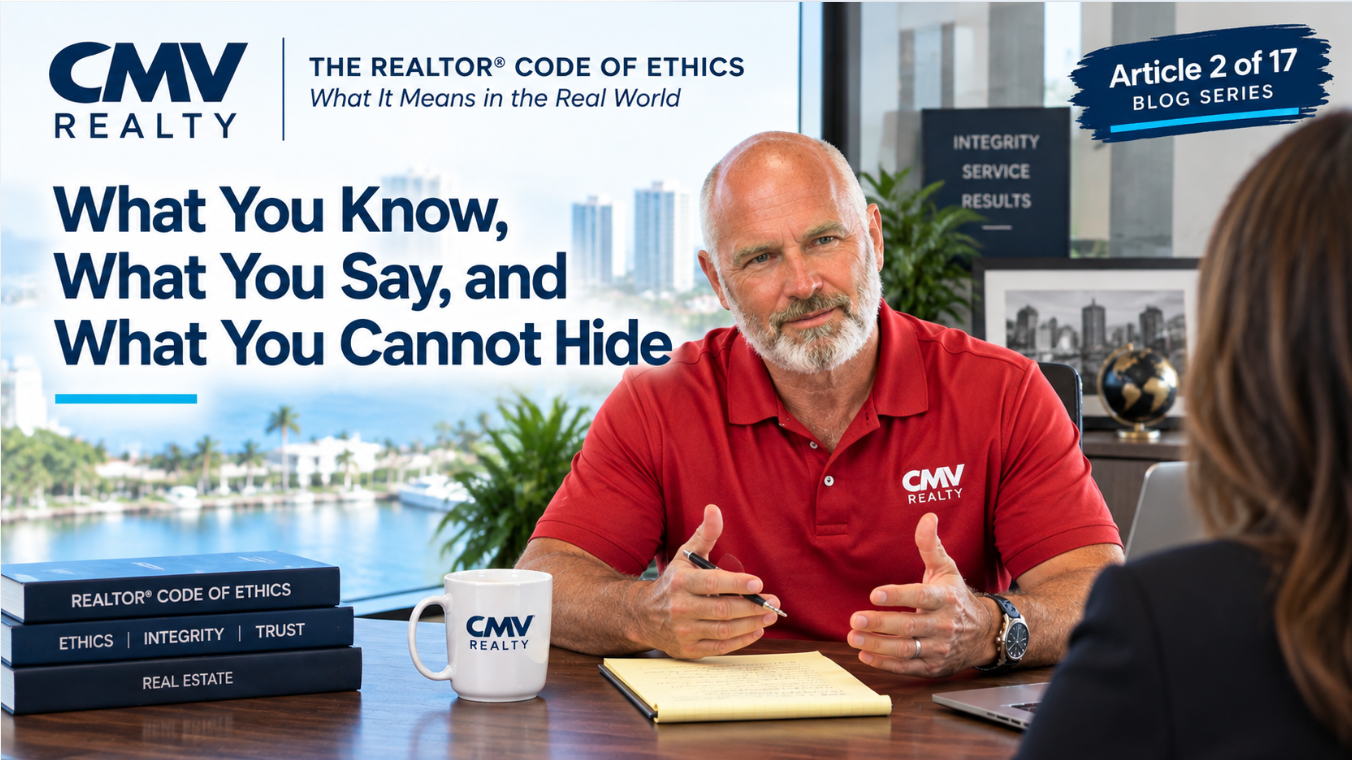
Article 2 of 17: What You Know, What You Say, and What You Cannot Hide The REALTOR® Code of Ethics: What It Means in the Real World

After 30-plus years in South Florida real estate, I’ve learned that what an agent writes or says about a property carries just as much legal and financial weight as the dirt itself.
Highlighting a home’s strengths is part of the job. If a custom build in Plantation Acres sits on a manicured acre with a screened resort pool and a high-end kitchen, you put those features front and center. If a commercial flex bay in Broward has clear span height and direct highway access, you lead with that.
Selling is one thing. Giving a buyer a false impression is another.
That sharp line is the foundation of Article 2 of the REALTOR® Code of Ethics.
The mandate cuts straight through marketing fluff: REALTORS® shall avoid exaggeration, misrepresentation, or concealment of pertinent facts relating to the property or the transaction.
In plain terms: don’t mislead people. Don’t repeat claims you haven’t verified. And never bury a problem hoping the buyer’s inspector misses it.
What Does Article 2 Actually Demand?
The text of Article 2 protects the transaction, but it also establishes clear boundaries around what an agent is—and isn't—responsible for.
You are obligated to put forward the truth and avoid concealment. However, the Code specifically notes that REALTORS® are not required to:
- Discover hidden (latent) structural defects behind finished walls.
- Provide counsel on specialized technical areas outside real estate licensing scope.
- Breach lawful confidentiality under state agency laws.
Standard of Practice 2-1 clarifies this balance: you must disclose adverse factors that are reasonably apparent to someone with real estate licensing expertise, but you aren't held to the standard of an unlicensed specialty.
You aren't a licensed structural engineer, commercial roofer, master electrician, or environmental remediator just because you hold a real estate license. But that lack of a contractor's license is never a pass to ignore visible red flags or invent claims out of thin air.
The Sales Pitch Trap: Where Marketing Turns into Misrepresentation
The line between creative sales copy and an ethical violation usually comes down to whether a statement is backed by verifiable facts.
Here is where agents routinely step on landmines:
- "Move-in Ready": Slapping this phrase on a listing with active roof leaks, an unpermitted electrical panel, or non-functional mechanical systems.
- The "New" Roof Lie: Calling a roof "new" because the seller patched it two years ago, while the actual permit dates back to 2011.
- Unverified Square Footage: Blindly copying air-conditioned living area figures from an outdated tax roll or an old appraisal when an unpermitted garage conversion or patio enclosure was clearly added.
- Inflated Pro Formas: Advertising unsupported cap rates or exaggerated rental yields on a multi-family or commercial asset while leaving out actual insurance expenses and vacancy drag.
Exaggeration doesn't make an asset more valuable—it just builds legal liability for the seller, the agent, and the brokerage.
Can Silence Be an Ethical Violation?
Yes. Leaving out an essential fact can deceive someone just as effectively as an outright lie.
Picture showing an estate home where the owner has fought persistent water intrusion in the sunken living room every hurricane season. A prospective buyer asks: "Any history of water intrusion or drainage issues on this lot?"
Instead of answering, the agent pivots: "Just look at these imported porcelain tile floors and the high ceilings!"
You didn't utter a factual falsehood, but deliberately dodging the inquiry to hide a known defect is active concealment.
The same applies to commercial assets. If an advisor markets an office building's gross rental numbers while deliberately concealing that the anchor tenant issued an early termination notice, that omission misrepresents the asset.
What to Do When the Seller Demands Silence
This is where an agent's backbone gets tested.
A seller might say: "The roof leaked three years ago, but my handyman patched it. Don't bring it up; let their inspector find it."
In Florida, the law on residential property condition is governed by the landmark case Johnson v. Davis: a seller (and their agent) must disclose all known facts materially affecting the value of the property that are not readily observable by the buyer.
When a client asks you to conceal a pertinent fact:
- State the law and the Code clearly: Explain that hiding a material defect puts their contract, deposit, and net proceeds at risk of post-closing litigation.
- Require proper written disclosure: Advise them to document the history, the repair receipts, and the current condition on the formal Seller's Property Disclosure.
- Walk away if they insist on deception: No single commission check is worth an ethics complaint, a state licensing investigation, or a civil fraud lawsuit.
Verifying vs. Assuming: Stop Repeating Rumors
One of the most common errors in South Florida real estate is the careless repetition of unverified claims.
[Unverified Claim] -> "Permitted detached guest house / 2022 roof"
   └── Sloppy Agent Action: Repeats claim verbatim in MLS public remarks.
   └── Problem: No city permit found; roof is a 2014 installation.
   └── Consequence: Ethics violation under Article 2 + failed appraisal/closing friction.

[Professional Advisory Approach]
   └── Check municipal building records & data BEFORE publishing.
   └── Attribute unverified data: "Per seller, unverified by broker; buyer must verify."
   └── Advise client to commission an independent inspection/survey.
If you don't know something as a verified fact, make the limits of your knowledge clear.
There is a world of difference between stating: "Roof replaced in 2022 per seller invoice on file" versus broadcasting: "Brand new 2022 roof" when you never checked the building permit card with the city.
Standard of Practice 2-4: The False Consideration Trap
Article 2 also shuts down a specific, dangerous financing game: false consideration.
Under Standard of Practice 2-4, REALTORS® cannot participate in naming false purchase prices or distorted financial considerations in transaction paperwork (outside of nominal legal consideration like "$10 and other valuable consideration").
If a buyer and seller collude to inflate the contract sales price on paper to obtain a higher mortgage loan while negotiating an unrecorded cash-back rebate under the table, an agent who drafts or facilitates that paperwork is participating in mortgage fraud.
Your paperwork must match the true financial reality of the deal down to the penny.
Credibility Is the Only Currency That Compounds
In an industry with thousands of licensed agents competing for business, your reputation for unvarnished honesty is your most valuable asset.
You can advocate hard for your client. You can negotiate every dollar of value. You can produce world-class photography and market the living daylights out of a property's best assets.
Just make sure the foundation beneath your words is rock solid. Tell the truth up front, disclose what's required, verify before you publish, and you'll never have to look over your shoulder.
Frequently Asked Questions (FAQ)
Q: What is the core rule of Article 2 in the REALTOR® Code of Ethics?
A: Article 2 requires REALTORS® to avoid exaggeration, misrepresentation, or concealment of pertinent facts relating to a property or transaction. Agents must market properties honestly and refrain from deliberately misleading buyers, sellers, or other brokers.
Q: Is an agent required to discover hidden, structural defects in a house?
A: No. Article 2 explicitly states that REALTORS® are not obligated to discover latent defects or provide expert opinions outside the scope of their real estate license. However, agents cannot ignore reasonably apparent adverse conditions or make unsupported assertions about systems they haven't verified.
Q: Can an agent get in trouble for what they don't say?
A: Yes. Concealment of a known, pertinent fact that materially affects the value of a property can constitute an ethical violation and violate Florida disclosure laws (Johnson v. Davis). Avoiding a direct question or omitting critical property issues creates a false impression.
Q: What should an agent do if a seller demands they keep quiet about an issue?
A: The agent must inform the seller of legal and ethical disclosure duties. If the seller refuses to disclose a known, unobservable material defect affecting the property’s value, the agent must decline to participate in the deception and withdraw from representation if necessary.
Q: Does Article 2 apply to commercial real estate transactions?
A: Yes. Article 2 applies to all real estate activities covered by the REALTOR® Code of Ethics, including commercial sales and leasing. Commercial advisors must avoid exaggerating financials, misrepresenting tenant terms, or concealing environmental and physical property issues.

Jeff Chenore
Broker/Owner CMV Realty | Chenore Group | CMV Realty LLC
or another way