Categories
Selling, Selling / Buying, Commercial Real Estate, Real Life Real EstatePublished September 29, 2026
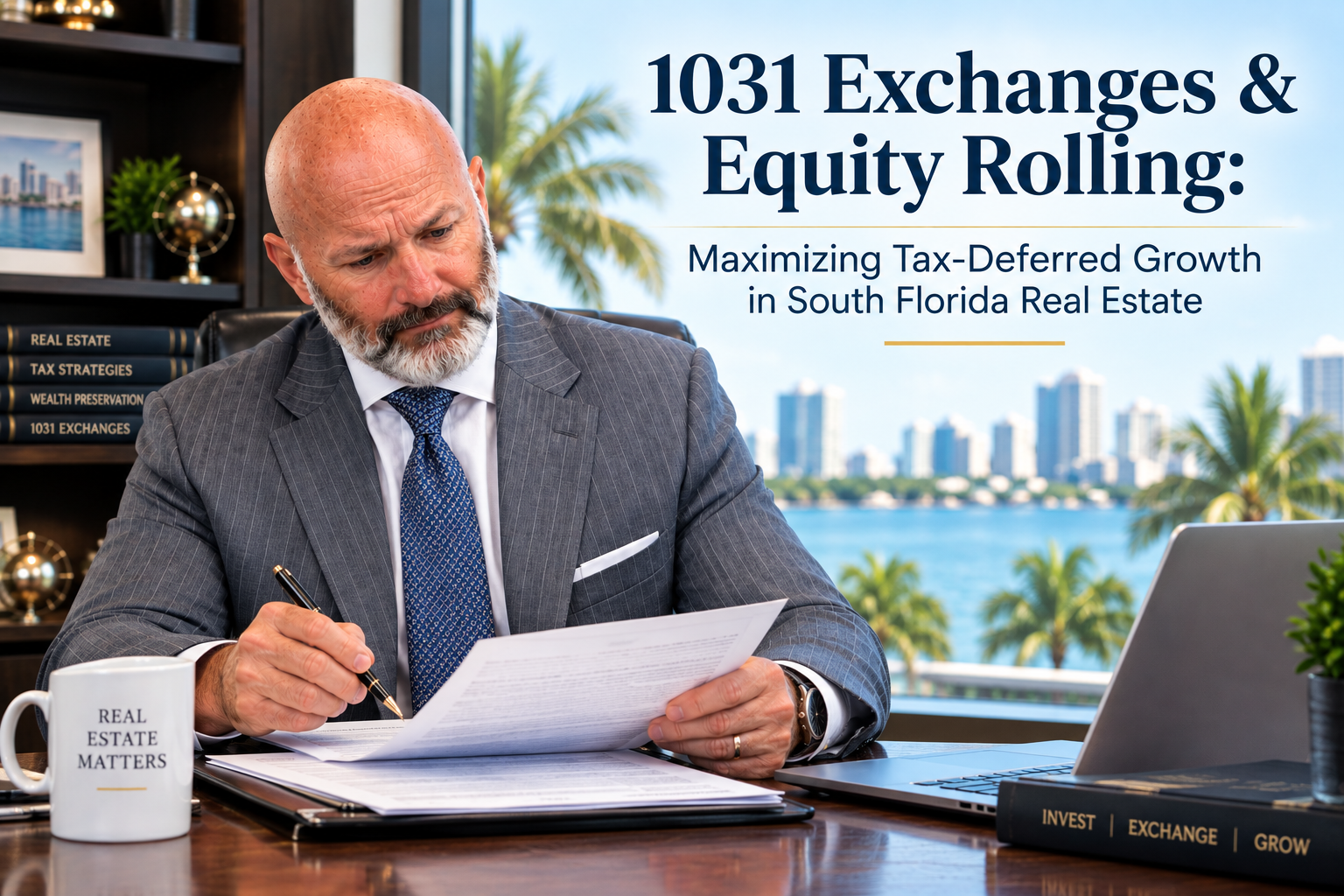
1031 Exchanges & Equity Rolling: Maximizing Tax-Deferred Growth in South Florida Real Estate

Real estate wealth isn't built on what you sell a property for—it's built on how much of that check stays in your hands to buy the next one.
If you sell a successful rental or commercial site in Broward County, your reward is usually a stack of tax bills: federal capital gains, depreciation recapture, and the net investment income tax. Before you even get a chance to deploy that money into another deal, a chunk of your hard-earned profit gets handed over to the government.
That's why serious investors rely heavily on a Section 1031 Exchange. It isn't an obscure loophole; it's a straightforward tax rule that lets you defer those gains and roll every single dollar of profit into your next property.
At CMV Realty, we handle 1031 transactions on both the residential and commercial sides. Here's a realistic look at how equity rolling works on the ground and how to keep the IRS from derailing your momentum.
The Real Math: What Deferring Taxes Actually Does to Your Buying Power
It’s easy to talk about "tax efficiency" in the abstract, but the real impact shows up when you calculate your actual leverage.
Let's say you clear $500,000 in net profit on a property sale.
-
If you just take the check: Between federal capital gains (which run up to 20%), depreciation recapture at 25%, and state/healthcare taxes, you can easily lose 25% to 30% of that profit right out of the gate. You walk away with maybe $350,000. If you put that down on a new asset using a standard 75% loan-to-value mortgage, your buying power sits right around $1.4 million.
-
If you execute a 1031 exchange: You keep the full $500,000 working for you. Put that same $500,000 down at 75% LTV, and your buying ceiling jumps to $2.0 million.
That single decision gives you $600,000 more in purchasing power on the exact same exit.
The IRS Ground Rules (And Where Investors Get Hurt)
The IRS gives you a massive tax break here, but in return, they expect absolute compliance with their calendar. Miss a deadline by six hours, and the whole deal collapses into a taxable event.
"Like-Kind" Real Estate Is Much Broader Than Most People Realize
A lot of owners think if they sell a single-family home, they have to buy another single-family home. That’s a myth. As long as both properties are held for business or investment purposes, the IRS considers almost all U.S. real estate "like-kind":
-
You can sell a single-family rental and buy a commercial retail building.
-
You can sell raw land and buy an income-producing industrial warehouse.
-
You can sell one large commercial building and spread the money across three single-family rentals.
The 45-Day Clock Starts Immediately
The day you close and hand over the keys to your buyer, a 45-calendar-day clock starts ticking. You have to formally identify your replacement properties in writing before midnight on Day 45. No extensions for holidays, weekends, or bad weather.
The 180-Day Closing Hard Stop
You must officially close on your new property within 180 calendar days of selling the old one (or by the date your tax return is due, whichever comes first).
Avoid the "Boot" Trap
If you walk away from the closing table with cash in your pocket or a smaller mortgage than you started with, the IRS calls that "boot"—and they will tax it.
To avoid paying taxes on a partial gain, remember these three conditions:
-
Buy a new property that costs equal to or more than the net sale price of the old one.
-
Reinvest all net cash proceeds from the sale.
-
Take on an equal or greater mortgage amount on the new deal (or bring extra cash out of pocket to make up the difference).
How We Protect Your Exchange Before You Put the Sign in the Yard
The biggest mistake sellers make is listing a property, closing the sale, and then starting their search for a replacement asset. Panic sets in around Day 30, and people end up overpaying for a mediocre property just to avoid the tax hit.
At CMV Realty, we reverse-engineer the process:
-
We start mapping out target replacement properties—including off-market deals across South Florida—weeks before your listing ever goes live.
-
We pair you with a vetted Qualified Intermediary (QI) to hold the proceeds securely. (If the sale money hits your personal bank account for even one second, your 1031 exchange is dead).
-
We coordinate contract language with your CPA so every timeline aligns smoothly.
Frequently Asked Questions (FAQ)
Q: Can I use a 1031 exchange to sell my primary residence?
A: No. Section 1031 only applies to properties held for investment or business use. If you are selling your primary home, look into IRS Section 121, which lets individuals exclude up to $250,000 (or $500,000 for married couples) in capital gains if you've lived there for two out of the last five years.
Q: What is a Qualified Intermediary (QI), and do I really need one?
A: Yes, they are mandatory. A Qualified Intermediary is an independent third party that holds your sale money in a special escrow account. If you take direct possession of the cash at closing, the IRS views it as a completed sale and triggers your tax bill immediately.
Q: Can I trade a single-family house for a commercial building?
A: Absolutely. The IRS considers almost all U.S. real estate held for business or investment "like-kind". You can freely sell residential rentals and move that money straight into retail centers, industrial bays, or office spaces.
Q: What happens if I miss the 45-day target window?
A: The exchange officially fails. Your Qualified Intermediary will release your funds, and you will owe capital gains taxes on the sale for that tax year. This is why we line up target properties before we even list your current asset.
Q: Does a 1031 exchange mean I never pay capital gains taxes?
A: It defers the taxes, meaning you kick the tax bill down the road. However, if you keep exchanging properties throughout your life and pass the real estate down to your heirs, current tax laws grant them a "step-up in basis" at death—which can eliminate those accumulated back taxes entirely.
#1031 exchange real estate South Florida #equity rolling #real estate investment #like kind exchange #commercial #residential #45 day identification rule #1031 #CMV Realty #1031advisor.

Jeff Chenore
Broker/Owner CMV Realty | Chenore Group | CMV Realty LLC
or another way